2021 saw accelerating inflation in advanced economies, the pandemic continuing, cracks appearing in the Chinese economic model, and massive price growth in cryptocurrencies and NFTs. In episode 120, Economics Explored host Gene Tunny discusses the big issues of 2021 and looks forward to 2022 with frequent guest Tim Hughes.
The episode also features discussion on the COP26 climate change summit, the idea of “degrowth” advanced by some ecologists and environmentalists, and feedback on EP115 on the Opioid Crisis and the War on Drugs.
The late Professor Tony Makin was a leading Australian economist who made major contributions to the economic policy debate in Australia on the balance of payments and the effectiveness of fiscal stimulus, of which Tony was highly sceptical. In Economics ExploredEP119, Former Ambassador to the OECD for Australia Dr Alex Robson, now an Associate Partner at EY, reflects on Tony’s contributions to open economy macroeconomics and the policy debate.
Dr Alex Robson is Associate Partner at EY. He has previously been Professor of Economics at Griffith University, Australian Ambassador to the OECD, Chief Economist for the Australian Prime Minister, a lecturer at ANU, and Director at Deloitte Access Economics. He is the author of Law and Markets, and has consulted to ASX 200 companies, Australian and NZ Government Departments and the OECD. Alex has a PhD and Masters in Economics from University of California, Irvine, USA.
There is an eerie correlation between the construction of a new world’s tallest building and economic crisis, the so-called Skyscraper Curse. Professor Mark Thornton, Senior Fellow at the Mises Institute, explains why this is so, drawing on his expertise in Austrian economics, in episode 118 of the Economics Explored podcast.
Mark Thornton is the Peterson-Luddy Chair in Austrian Economics and a Senior Fellow at the Mises Institute. He serves as the Book Review Editor of the Quarterly Journal of Austrian Economics. His publications include The Economics of Prohibition (1991), Tariffs, Blockades, and Inflation: The Economics of the Civil War (2004), The Quotable Mises (2005), The Bastiat Collection (2007), An Essay on Economic Theory (2010), The Bastiat Reader (2014), and The Skyscraper Curse and How Austrian Economists Predicted Every Major Crisis of the Last Century (2018).
Dr. Thornton served as the editor of the Austrian Economics Newsletter and was a member of the Editorial Board of the Journal of Libertarian Studies and several other academic journals. He has served as a member of the graduate faculties of Auburn University and Columbus State University. He has also taught economics at Auburn University at Montgomery and Trinity University in Texas. Mark served as Assistant Superintendent of Banking and economic adviser to Governor Fob James of Alabama (1997-1999), and he was awarded the University Research Award at Columbus State University in 2002. He is a graduate of St. Bonaventure University and received his PhD in economics from Auburn University. In 2014, he debated in opposition to the “War on Drugs” at Oxford Union.
The COP26 climate change summit in Glasgow in 2021 disappointed many advocates for strong action on climate change. In Episode 117 of Economics Explored, show host Gene Tunny discusses whether COP26 should be perceived as a failure or, at best, a mild success with fellow Brisbane-based economist Scott Hook, who has attended several global climate change summits in the past.
Scott Hook has over 25 years of experience in policy, economic, environmental and financial analysis and in the development of Pacific regional, national and local government policy. He has also researched and written on the role of institutions in shaping policy implementation in Fiji and the Pacific, climate change and disaster risk and climate and security issues. He has a PhD from the University of Queensland that was completed in 2010.
In the last decade he has worked extensively on infrastructure reform and policy, understanding and building resilience to climate and disaster risk and improving access to, and management of, climate change and disaster risk finance for Pacific island countries. He has supported Pacific Island Delegations in the Finance discussions of the UNFCCC Conference of the Parties negotiations as a technical adviser, coordinator and negotiator.
He has experience with working with a range of partners and their modalities of engagement, such as. the Green Climate Fund (Forum Secretariat is a Readiness Partner and organising the 2015 and 2016 Pacific Roundtable Meetings), European Development Fund (design and governance for a €29 million energy programme), and a US$10 million regional programme of the Climate Investment Fund through the development of the Pacific component of the Strategic Program for Climate Resilience. He has worked closely with a wide range of partners including the Pacific Community, SPREP, DFAT, EU, NZAID, the ADB and World Bank.
What’s going on with the Great Resignation, the record numbers of people leaving jobs in the US and the UK? Will we see it in other countries such as Australia? What can employers do to hold on to staff? In Episode 116, Economics Explored host Gene Tunny talks about the Great Resignation with his serviced office neighbours Anthony Bersz and Louise Gibson from Remedy Resourcing, a Brisbane-headquartered recruitment firm.
Here’s a video recording of the conversation via YouTube:
About this episode’s guests – Anthony Bersz and Louise Gibson, Remedy Resourcing
Anthony Bersz is Managing Director of Remedy Resourcing and Director of Remedy Information Technology. Anthony’s recruitment career started in 2010 working for one of the world’s leading recruitment agencies based in the UK. After a number of years supporting his candidates and clients throughout the North West of England, Anthony made the move to Brisbane, Australia. On arrival to Brisbane, Anthony continued his career within the same global brand supporting IT companies and professionals with their recruitment and career needs. After listening to the candidate and client frustrations of working with a large global agency, Anthony decided to create Remedy Resourcing to provide a more tailored and flexible approach.
Email anthony@remedyresourcing.com
Louise Gibson is Director of Remedy Legal. Louise’s recruitment career began in 2001 (whilst living in the United Kingdom) and for the next several years, she recruited for one of the largest recruitment agencies in the world, before obtaining a Directorship in the North West’s leading taxation and legal search and selection firms. During this decade, Louise sourced both tax accountants and tax lawyers for Big 4 Accounting, magic circle law firms and other private practice and FTSE 100 companies.
Louise moved to Brisbane in 2012 and returned to the same international agency for several years where she took responsibility for managing the legal, professional services and finance team for their Brisbane office. It was here in 2015 that she was awarded the Queensland state record for the highest fees billed in a single period since records began. At the end of 2015, Louise joined Remedy to head up and develop the Legal recruitment arm of the business.
I did a livestream earlier today (Friday 3 December 2021) with my regular co-host Tim Hughes on the latest economic news of the week, including the latest US initial jobless claims confirming a strong US economy, the impact of the omicron COVID-variant on equity markets, and the September quarter Australian GDP figures which revealed the adverse impacts of NSW and Victorian lockdowns. You can click on and watch the video on YouTube below. You can also download the slides I showed.
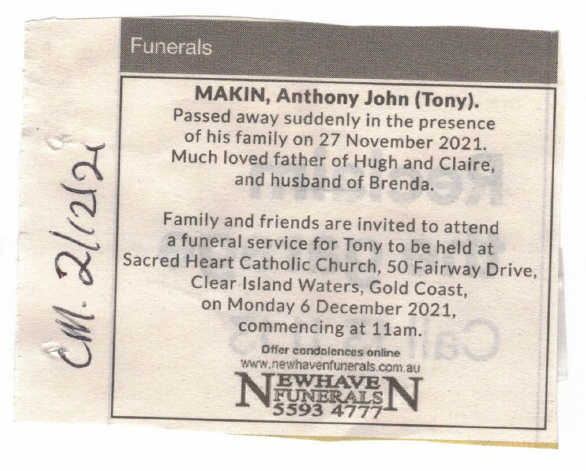
In the livestream, from around 22:05, I reflected on the late Professor Tony Makin’s contributions to the Australian economic policy debate, particularly on whether we should worry about the current account deficit in the late 80s/early 90s and on the effectiveness of the Rudd Government’s fiscal stimulus. On the current account deficit, Tony’s articles, along with the contributions of John Pitchford, clearly led to a change in the policy consensus on the current account, so it was no longer something that would be a macroeconomic policy target. Sadly, Tony died unexpectedly earlier this week. This came as a huge shock to so many of us, and it’s obvious from all the conversations I’ve had about Tony over the last few days just how much respect and admiration his colleagues and former students had for him. Tony’s funeral is on Monday on the Gold Coast (see notice below).
Funeral notice for the late Griffith University Economics Professor Tony Makin, who will be greatly missed by his family, friends, colleagues, and former students.
100,000 Americans have died of drug overdoses in a 12 month period, mostly with opioids. Economics Explored EP115 features a conversation on the US Opioid crisis and the failed War on Drugs, and why a Harm Reduction approach is preferable, with Dr Jeff Singer MD from the Cato Institute.
Jeffrey A. Singer is a senior fellow at the Cato Institute and works in the Department of Health Policy Studies. He is principal and founder of Valley Surgical Clinics Ltd., the largest and oldest group private surgical practice in Arizona, and has been in private practice as a general surgeon for more than 35 years.
He is also a visiting fellow at the Goldwater Institute in Phoenix. Singer is a member of the Board of Scientific Advisors of the American Council on Science and Health. From 1994 to 2016, he was a regular contributor to Arizona Medicine, the journal of the Arizona Medical Association. He served on the Advisory Board Council of the Center for Political Thought and Leadership at Arizona State University from 2014 to 2018 and is an adjunct instructor in the Program on Political History and Leadership at ASU. He writes and speaks extensively on regional and national public policy, with a specific focus on the areas of health care policy and the harmful effects of drug prohibition.
He received his BA from Brooklyn College (City University of New York) and his MD from New York Medical College. He is a fellow of the American College of Surgeons.
Controversial US tax rules mean that tech titans and hedge fund managers can pay arguably a relatively low amount of tax, as Steve Rosenthal, Senior Fellow at the Urban Institute, explains to show host Gene Tunny in Economics Explored episode 114. Steve also talks with Gene about former President Trump’s tax affairs in this episode.
Steve Rosenthal, a senior fellow in the Urban-Brookings Tax Policy Center at the Urban Institute, researches, speaks, and writes on a range of federal income tax issues, with a particular focus on business taxes. In 2013, he was the staff director of the DC Tax Revision Commission.
Before joining Urban, Rosenthal practiced tax law in Washington, DC, for over 25 years, most recently as a partner at Ropes and Gray. He was a legislation counsel with the Joint Committee on Taxation, where he helped draft tax rules for financial institutions, financial products, capital gains, and related areas. He is the former chair of the Taxation Section of the District of Columbia Bar Association.
Rosenthal holds an AB and JD from the University of California, Berkeley, and an MPP from Harvard University.
Lithium, the third element on the periodic table, is contained in the batteries which power laptops and electric vehicles. It is essential to what the author of a new book calls a “global energy revolution”.
“A global energy revolution is unfolding before our eyes: ever-growing numbers of electric vehicles on our roads, laptops that last all day on a single charge and solar panels on our roofs, all reliant on lithium-ion batteries. This revolution is happening at breath-taking speed, with the potential to completely transform key industries and the way we live. For the first time in history, we can now actually store this green energy we talk so much about. Often referred to as ‘the new oil’, lithium allows large amounts of energy to be squeezed into a very small space.”
About this episode’s guest – Lukasz Bednarski
Lukasz Bednarski is a battery materials analyst, founder of the lithium industry portal Lithium Today and a former commodity trader.
Thanks to the show’s audio engineer Josh Crotts for his assistance in producing the episode.
Please get in touch with any questions, comments and suggestions by emailing us at contact@economicsexplored.com. Alternatively, please send a voice message via Speakpipe. Economics Explored is available via Apple Podcasts, Google Podcast, and other podcasting platforms.
There are growing calls to increase taxes on the wealthy in advanced economies such as the United States and Australia. For instance, US Congresswoman Alexandria Ocasio-Cortez controversially wore a white evening dress with the words “Tax the Rich” written in red across it to the 2021 Met Gala. In Economics Explored episode 112, Australian tax expert Professor Miranda Stewart speaks with show host Gene Tunny about taxes on wealth, including inheritance taxes and the proposed billionaire tax in the United States. What is driving calls to “Tax the Rich” from politicians such as Alexandra Ocasio-Cortez and various commentators? Would it be sensible to do so?
About this episode’s guest – Professor Miranda Stewart
Miranda Stewart is Professor of Law at the University of Melbourne Law School where she is Director of the Tax Group and is a Fellow at the Tax and Transfer Policy Institute at the Crawford School of Public Policy, The Australian National University. Miranda was the inaugural Director of the Institute from 2014 to 2017. Miranda has more than 25 years research, practical and leadership experience in tax law and policy in academia, government and the private sector.
Thanks to the show’s audio engineer Josh Crotts for his assistance in producing the episode.
Please get in touch with any questions, comments and suggestions by emailing us at contact@economicsexplored.com. Economics Explored is available via Apple Podcasts, Google Podcast, and other podcasting platforms.